
a Representation of the Transmission of Cultural Motifs and Material Goods Along the Silk Road: Eastern Asian Influence on Ottoman Miniature Paintings and Albums
Ottoman miniature paintings–vividly colorful depictions of humans going about their real or fantastical lives in the Central Asian cultural landscape–are more than decorative art forms. Through their intended purpose, they illuminate the lifestyles and accomplishments of the Ottoman Empire (1299-1922) to the external world. They were primarily created between the tenth and sixteenth centuries and can be classified under a range of names depending on the subject matter, region, or period of creation. Manuscript illuminations, Muslim miniatures, Persian miniatures, Mughal miniatures, and more can encompass a similar style of painting, utilizing detailed compositions that describe a narrative scene in a whimsical and representative (as opposed to realistic) manner, most commonly made with watercolor and ink. The Ottoman miniature paintings reference those made within the timeframe of the Ottoman Empire’s existence, and more specifically as an intentional display of the internal nature of the vast and diverse empire.
One may consider how miniature paintings can reflect the cultural exchanges that occurred throughout the Ottoman Empire. This can be done through the lens of the Silk Road, weaving together historical background, specific examples of motifs and objects exchanged, and broader themes that will demonstrate the processes of object and concept transmission and adaptation in this particular context. Ottoman miniature paintings and muraqqa’ albums of the fifteenth and sixteenth centuries serve as artistic representations of history that reveal the flow of material culture and artistic traditions along the Silk Road–particularly the impact of Chinese and Mongol traditions on Ottoman visual culture–illustrated by both the physical and emblematic patchwork nature in which they were created due to the composition of various elements from distinct regions and periods.
Historical Context of the Silk Road and Related Cultural Exchanges
The Silk Road is a metaphorical term that defines the network of trade routes where an exchange of material goods, ideas, and traditions was facilitated. A common misconception may be that the Silk Road directly connected East Asia to Europe through an extended “road,” but these trade networks existed more actively on a local scale, connecting neighboring cultural groups throughout East Asia, Central Asia, the Middle East, and Europe. Nomadic groups who did not reside permanently in an established region also heavily facilitated the transmission of material goods, ideas, and traditions between the cultural groups with permanent residences. There are examples of travelers who journeyed across the entire “road,” such as Marco Polo, yet their contributions to the understanding of the trade network are far from representative of the whole story. Through the art that was created and transmitted along the Silk Road, an analysis of both the tangible artifacts and intangible elements provides a rich understanding of the cross-cultural interactions that occurred.
Transmission is a concept that will be referenced to express the transference of material objects, motifs, ideas, knowledge, and traditions from one culture to another. Humans have practiced the act of transmission throughout history, leading to the development of our civilization through the expansion of knowledge and conceptualization of the world. Material culture refers to the physical artifacts that play a crucial role in the shaping of aesthetic and social values within a culture. Specific imported goods, like Chinese porcelain or Persian textiles, can hold value in cultures outside of their own and are often seen as luxury items that “positively” influence a culture. However, regions that experienced, consumed, or appropriated these artifacts respond to the material object differently depending on the pre-established cultural values. Thus, the understanding of the true impact that the transmitted items had on a culture is important to be distinguished.
The narrative of Marco Polo (1254-1325), an Italian traveler who made his way to China and back along the Silk Road in the thirteenth century, attributes his travels to a major transmittance of material objects and cultural information, such as Chinese porcelain. Another Italian, Matteo Ricci (1552-1610), traveled to China as a Jesuit missionary in an attempt to convert East Asia to Christianity but was greeted by the well-established and prosperous Ming dynasty (1368-1644). German philosopher Gottfried Wilhelm Leibniz (1646-1716) made restrictive claims regarding the connection between East Asia and Europe, “as the most civilized and distant peoples stretch out their arms to each other, those in between may gradually be brought to a better way of life.” The connection between China and Europe bridged by Europeans, such as Marco Polo, Matteo Ricci, and Gottfried Wilhelm Leibniz, is often made to explain the sinification, or spread of Chinese culture, to the West. This prevailing narrative excludes the cultural groups between China and Europe, as they had direct, complex interactions with and exchanges of material and symbolic elements of culture.
Direct diplomatic connections between the Ottoman, Mongol, and Chinese court officials existed in the fifteenth century, resulting in a focused and intentional assimilation of East Asian motifs, techniques, and objects into Ottoman culture. Embassies that were sent to visit the other states were able to transmit ideas, diplomatic gifts, and cultural values.
A method to approach the concept of diplomatic gifts is through the tangible object, the muraqqa’ album, which is a compilation of curated miniature paintings, inscriptions, and margin illuminations, as the gift itself. The act of gifting items that hold significant value in one’s own culture is representative of a state’s desire to connect with, assert influence over, and maintain relationships with external cultural groups.
Ottoman Miniatures and Muraqqa’ Albums as Artistic Representations of History
Ottoman miniature paintings serve as visual and physical records of history and court life. They represent the aesthetic values of the Ottoman Empire through the use of bright and richly pigmented colors, representational painting techniques, and the subject matter depicted–including intricate textiles, manicured landscapes, and ornamented architecture. Nakkaşhane, or imperial painting studios and workshops, drove the production of miniature paintings and muraqqa’ albums. The artistic, state-appointed projects were produced to serve as a method for the Ottoman Empire to showcase the Ottoman lifestyle, military conquests, and diverse cultural composition within the empire. When muraqqa’ albums, filled with a combination of miniature paintings, calligraphy, and margin illuminations, were gifted to diplomats, they were presented with an intentionally curated representation of the Ottoman Empire. The role of the court in this process reflects the political and cultural relevance that the miniature paintings and muraqqa’ albums had in the fourteenth through sixteenth centuries, which is the timeframe that seemed to produce the largest quantity of these projects.
The painters in the nakkaşhane also would provide repairs and additions to the paintings or albums, as sometimes they were left unfinished. As cities fell throughout the expansion of the Ottoman Empire, manuscripts of the highest quality would be gathered and transported to the library of the conqueror, then added to or finished by new owners. The differences in painting techniques and colors used when depicting figures, clothing or armor, landscapes, and other features can indicate that the painting was completed by multiple artists in distinct periods.
As seen in Fig. 1, there are multiple artistic elements represented on a single page–the gold, green, and blue illuminated margins, calligraphic inscriptions, and a vivid miniature painting. The date of the folio itself ranges from 1550 to 1580, with distinctions between the date that the painting was created, the margins were added, and the album was assembled. The albums compile a diverse range of artistic content, resulting in a scrapbook-like quality. This reflects the ability to preserve and display the physical wealth of material present in the Ottoman Empire, as it can collect content from a variety of sources under its rule.
Through the study of the patchworked muraqqa’ albums, it is clear that the absorption and integration of multicultural material into Ottoman-branded artwork is a tactic that was used to establish legitimacy as an empire that has a plethora of power, wealth, and access to widespread material content. The Ottoman Empire absorbed and reinterpreted motifs and material goods from diverse cultures, creating their own cultural visual “language” based on the content represented. The fluid nature of the muraqqa’ albums, as pages can be added or removed based on the desires of the curator and owner, represents a tangible object that reflects the–at times–selective and intentional adoption of knowledge and material along the Silk Road.
Chinese Porcelain and Chinoiserie in Ottoman Miniature Paintings
Chinoiserie is the integration of Chinese visual elements (motifs) into foreign artistic traditions. The Ottoman miniature paintings selected have Chinese-inspired motifs, such as blue-and-white porcelain jars and vases. Blue-and-white porcelain becomes a key object of material culture along the Silk Road, commonly representing luxury and sophistication. Blue-and-white pottery has a history that extends beyond its origins in China, due to the cobalt pigment that was imported from Persia, yet the formal shape of the white porcelain clay (as jars, vases, etc.) in combination with cobalt pigment composes the “Chinese” quality of the object. The specific motifs that were commonly used upon the initial production of these wares also assist in the definition of these objects as uniquely Chinese. Fig. 2 contains a range of chinoiserie motifs, most notably the blue-and-white porcelain and group of blue clouds depicted in the upper left-hand corner of the painting. The inwardly swirling edges with bubbly, round exterior edges along the body of the form are reminiscent of “auspicious clouds” which could represent the presence of an emperor or the highest nobility, yet this cloud motif came to be an element that adorned many Chinese cultural products. The inclusion of these objects in Ottoman miniature paintings represents the power associated with the ownership of objects from far-reaching material cultures.
The blue-and-white porcelain provides an opportunity to further analyze the material culture and diplomatic agenda of the Ottoman Empire. As seen in Fig. 2, three blue-and-white porcelain vases sit atop a table on the central right-hand portion of the painting in the context of a courtly scene, likely a processional due to the gifts presented and arrangement of the figures. A fourth blue-and-white vase of the same size and shape is carried by a figure towards the bottom left-hand portion of the painting. Precise representations of Chinese blue-and-white porcelain do not appear to exist in the paintings, as examples of the exact objects depicted have not been found or identified. Rather than taking the time to depict the exact objects, the artists have adapted and reframed the porcelain jars and vases to fit into the Ottoman Empire’s visual language as emblems of its success and capacity to participate in a broader cultural exchange of materials. A procession, where gifts from one’s own culture are brought and presented to a diplomatic member within another culture, appears to be depicted in this painting, highlighting the Chinese blue-and-white porcelain as the primary object of value. This detail further explains the diplomatic influence that miniature paintings illuminate within the Ottoman Empire’s political agenda.
Although commissioned by the court to create the miniature paintings, artists maintained the freedom to assimilate the chinoiserie motifs through their established painting techniques and personal interpretation. The nature of the Ottoman miniature paintings is representative, meaning the features of objects, humans, and landscapes are discernible, but they do not contain a quality that would mimic life in the style of realism. As the Chinese blue-and-white porcelain pieces represented in the Ottoman miniature paintings are difficult to identify due to this quality, the hope to use these objects as references to date the paintings or other related artifacts is ambitious. The purpose that the chinoiserie motifs serve lies in the deeper cultural history tied to the ownership of Chinese blue-and-white porcelain and engagement with foreign material culture in court life, as opposed to a method to date the artifacts.
Mongol Cloud Collars in Ottoman Miniature Paintings
The four-leafed “cloud collar” motif arises from Chinese culture and appears in Ottoman miniature paintings, yet it appears to have been adapted and transmitted through the Mongols. Initially represented as a purely ornamental design, the motif may have adopted new cosmological symbolism as it assimilated into Mongol culture as a decorative collar on worn textiles and embellished the smoke holes at the top of circular tents. As the purpose of the motif is transmitted from Chinese blue-and-white porcelain ornamentation to Mongol symbolism in textiles, it takes on a further meaning as it is depicted in Ottoman miniature paintings as a means to display cultural syncretism throughout the empire.
In Fig. 2, an individual in the center on the left-hand side of the painting is seen wearing a four-leafed cloud collar,ornamented in dark brown or possibly gold ink on the purple-colored robe. The figure may be of Mongol descent, but he is at least differentiated from other representations of cultural groups due to the hairstyle of two small buns below either side of the ears. Few of the others with this same hairstyle and depiction of similar facial features may be wearing a cloud collar robe, such as the figure kneeling in the center of the painting, but the digital rendering of the painting may interfere with the ability to discern the shoulder detailing that would indicate a four-leafed cloud collar.
There was a Mongol influence and presence in the Ottoman Empire in the fourteenth and fifteenth centuries, which came to be represented in the courtly scenes depicted in the Ottoman miniature paintings. With the assumption that these figures are of Mongol descent, their inclusion in a courtly scene holds value as a way to display the variety of cultural groups present in the Ottoman Empire in the fifteenth century. There may be evidence that the cloud collar robe was assimilated into Persian material culture after the presence of Mongols in Persia, as they had the motif embroidered into robes as ornamentation. Regardless of who was wearing the cloud collar robe, the detail provides significant insight into the types of artifacts that were transmitted into and valued in Ottoman material culture.
To conclude, the Ottoman miniature paintings and muraqqa’ albums from the fifteenth and sixteenth centuries serve as a method to dissect and understand Ottoman visual culture, specifically providing insight into the transmission and assimilation of motifs, objects, and ideas along the Silk Road. The “road” is made up of localized trade routes that exchange material, knowledge, and motifs, creating a vast network of cultures that are deeply integrated and connected. The miniature paintings and associated albums contain both a physical and metaphorical patchwork of artistic elements, motifs, and objects of foreign material culture.
Processing the nature in which the paintings and albums are physically made, there is often a conglomeration of material that ends up creating the whole picture, similar to the nature of the exchanges that occurred throughout the Silk Road. The concept of the exchange of material culture is apparent in the assemblage of the muraqqa’ albums and miniature paintings of the Ottoman empire, especially emphasized by the East Asian motifs and material items that make their way into the depictions of courtly scenes: Chinese blue-and-white porcelain, Chinese auspicious clouds, and the Mongolian cloud collar. The acceptance and recontextualization of these East Asian motifs into Ottoman miniature paintings indicates a strong desire to establish legitimacy as an empire, displaying the ownership of foreign material culture, the diverse composition of cultural groups, and the strong diplomatic connections present in the Ottoman Empire. Through the use of motif-centered case studies and an analysis of historical context and broader narratives, these patchworked artifacts represent the nature of the Silk Road, transmitting, adapting, and reimagining the use of new physical and metaphorical material in one’s own culture in an effort to develop and progress as a civilization.
Bibliography
Cammann, Schuyler. “The Symbolism of the Cloud Collar Motif.” The Art Bulletin 33, no. 1 (1951): 1–9. https://doi.org/10.2307/3047324.
Compiled by Sultan Murad III. Album of Murad III; Persian Painting in an Ottoman Page, Folio 8b. album, c. 1580s; painting, c. 1550-60; margins, c. 1570. Vienna, National Library, Codex Mixtus 313. https://jstor.org/stable/community.14454036.
Frontispiece from an Manuscript of the Shahnamah of Firdawsi: Courtly Scene (Right Folio). Ca. 1440. Opaque watercolor and gold on paper, Sheet: 32.5cm x 22.1cm, Image: 26.3cm x 20.7cm. The Cleveland Museum of Art, Cleveland, Ohio, USA; Purchase from the J. H. Wade Fund. The Cleveland Museum of Art. Artstor. https://jstor.org/stable/community.15009135.
Froom, Aimée. “Adorned like a Rose: The Sultan Murad III Album (Austrian National Library, Cod. Mixt. 313) and the Persian Connection.” Artibus Asiae 66, no. 2 (2006): 137–54. http://www.jstor.org/stable/25261859.
Gray, Basil. “The Chinoiserie Elements in the Paintings in the Istanbul Albums.” Essay. In Between China and Iran; Paintings from Four Istanbul Albums, 85-87. University of London, 1980.
Kreiling, Frederick C. “LEIBNIZ.” Scientific American 218, no. 5 (1968): 94–101. http://www.jstor.org/stable/24926231.
Longxi, Zhang. “Translation, Communication, and East-West Understanding.” In Internationalizing “International Communication,” edited by CHIN-CHUAN LEE, 244–57. University of Michigan Press, 2015. https://doi.org/10.2307/j.ctv65sxh2.14.
Medley, Margaret. “Chinese Porcelain in the Istanbul Album Paintings .” Essay. In Between China and Iran; Paintings from Four Istanbul Albums, 157–59. University of London, 1980.
PIERSON, STACEY. “The Movement of Chinese Ceramics: Appropriation in Global History.” Journal of World History 23, no. 1 (2012): 9–39. http://www.jstor.org/stable/41508050.
Reiter, Florian C. “‘Auspicious Clouds’, an Inspiring Phenomenon of Common Interest in Traditional China.” Zeitschrift Der Deutschen Morgenländischen Gesellschaft 141, no. 1 (1991): 114–30. http://www.jstor.org/stable/43378249.
Tanindi, Zeren. “Additions to Illustrated Manuscripts in Ottoman Workshops.” Muqarnas 17 (2000): 147–61. https://doi.org/10.2307/1523295.
Woodhead, Christine. “Reading Ottoman ‘Şehnames’: Official Historiography in the Late Sixteenth Century.” Studia Islamica, no. 104/105 (2007): 67–80. http://www.jstor.org/stable/20141105.
Figures
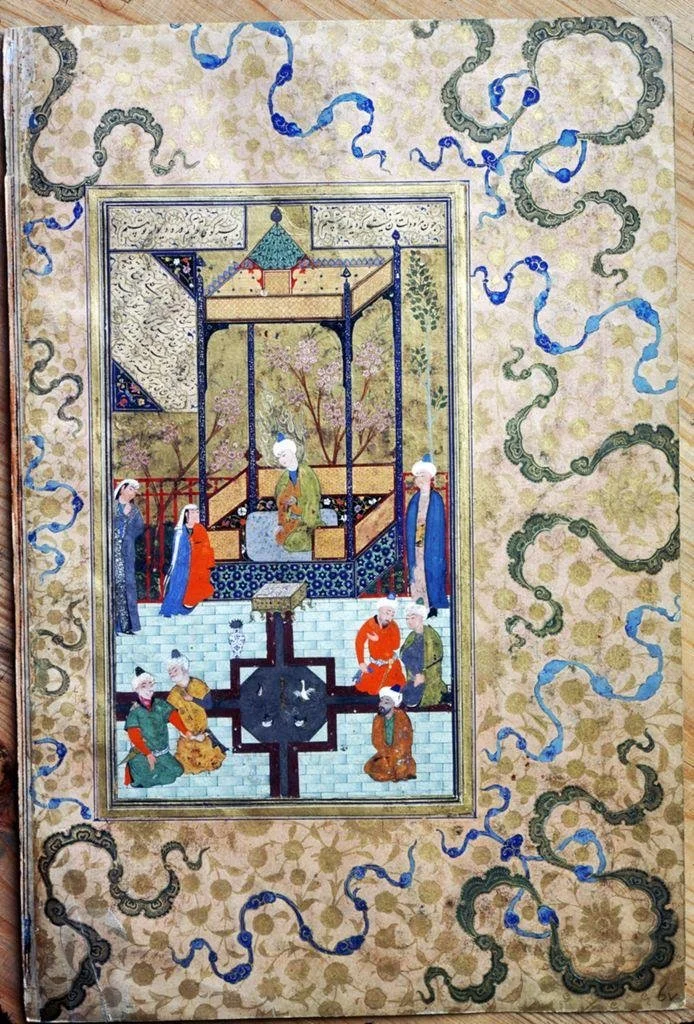
Fig 1. Album of Murad III; Persian Painting in an Ottoman Page, Folio 8b. Ottoman (1299-1922). Album, c. 1580s; Painting, c. 1550-60; Margins, c. 1570. Istanbul.
Ink, colour and gold on paper.
333mm x 222mm.
Austrian National Library, Vienna, Austria, Codex Mixtus 313.
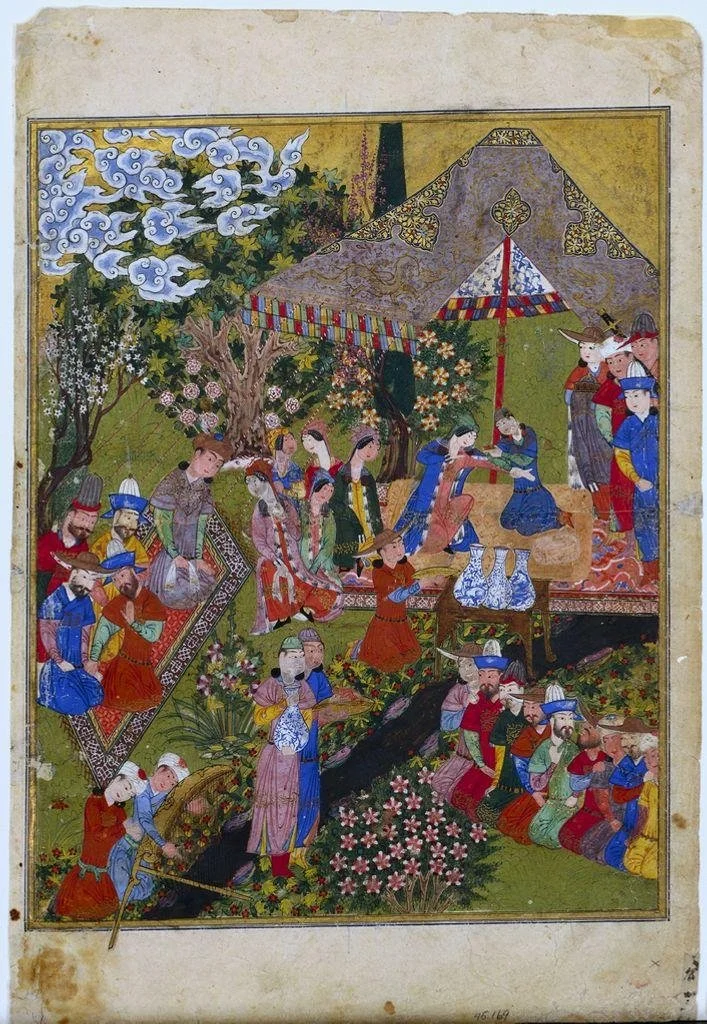
Fig 2. Frontispiece from an Manuscript of the Shahnamah of Firdawsi: Courtly Scene (Right Folio).
Timurid Period. Ca. 1440.
Shiraz, Iran.
Opaque watercolor and gold on paper.
Sheet: 32.5cm x 22.1cm, Image: 26.3cm x 20.7cm.
The Cleveland Museum of Art, Cleveland, Ohio, USA (Inv.#: CMA 1945.169).
